Coffee beneath a canopy
Shade cultivation and mixed planting are central to India’s coffee landscape.
The coffee
Start with South India’s traditional growing regions, then look closer at how place and processing shape each coffee.
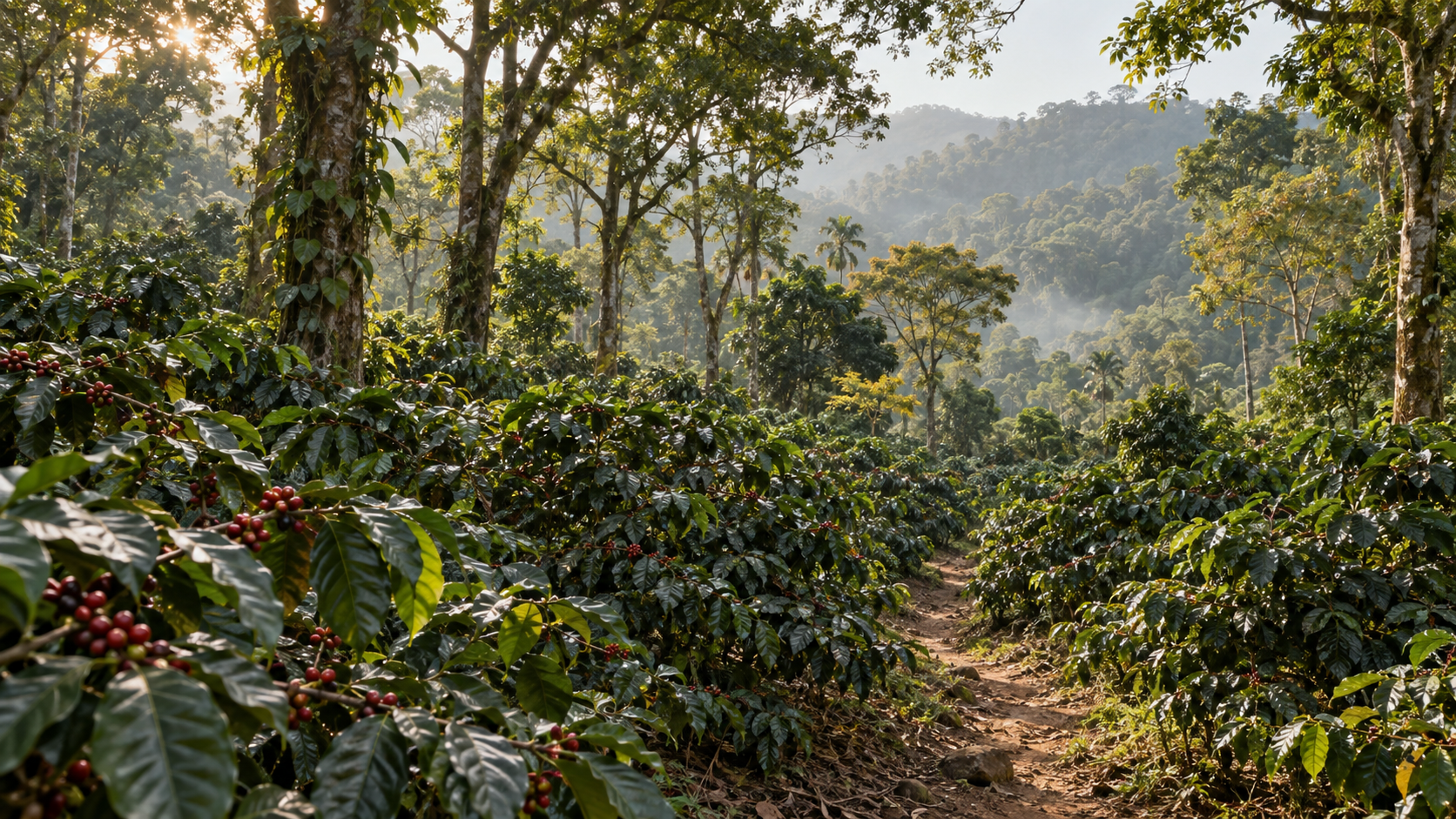
Shade cultivation and mixed planting are central to India’s coffee landscape.
Karnataka, Kerala and Tamil Nadu offer different places, varieties and traditions to explore.
Monsooned Malabar takes a different path: humid coastal air transforms the green beans. This process is specific to monsooned coffee.
Sources: Coffee Board of India.
An origin guide
These three states are the traditional heartland. Coffee also grows elsewhere in India, including the Eastern Ghats and the Northeast.
A starting point for discovering both Arabica and Robusta.
Explore the state’s coffee districts and their regional identities.
Different hill regions, each with its own growing conditions.
Sources: Regional profiles, Coffee Board of India.
A closer look / Monsooned Malabar
Monsooning exposes dry-processed green coffee to moist coastal air. The beans swell and change colour as they absorb moisture.
Dry-processed green Arabica or Robusta is selected.
Coffee is exposed to humid monsoon air at coastal curing works.
Moisture changes the beans’ size, colour and character.
Taste it alongside another process to discover the difference.
Sources: Government of India: specialty coffees.
The everyday ritual

Our name takes its cue from South Indian filter coffee: a drink, a ritual, and an invitation to pause together.
That curiosity carries into this project. What changes when we learn where a coffee comes from—and who helped bring it to our cup?